Does calorie counting work? Why it does, and where it falls short
Calorie counting isn’t magic. It’s a boring way to keep the books on what you eat and what you burn. Here’s why that works, when you can skip it, and what it costs you.
Short answer: yes. Counting works because of energy balance: eat less than you burn, and you lose weight. It shows you what you really eat, and you can eat anything that fits your numbers. But counting properly is hard, restaurant food is close to impossible to count, and I think counting should be a time-limited experiment, not a way of life.
How calorie counting works
Every food has calories and macros: protein, fat and carbs. Put simply, calories are an estimate of how much energy your body will get out of a food. Macros are the Lego bricks. Your body builds almost everything from them: muscle, fat, glucose, glycogen and a lot more.
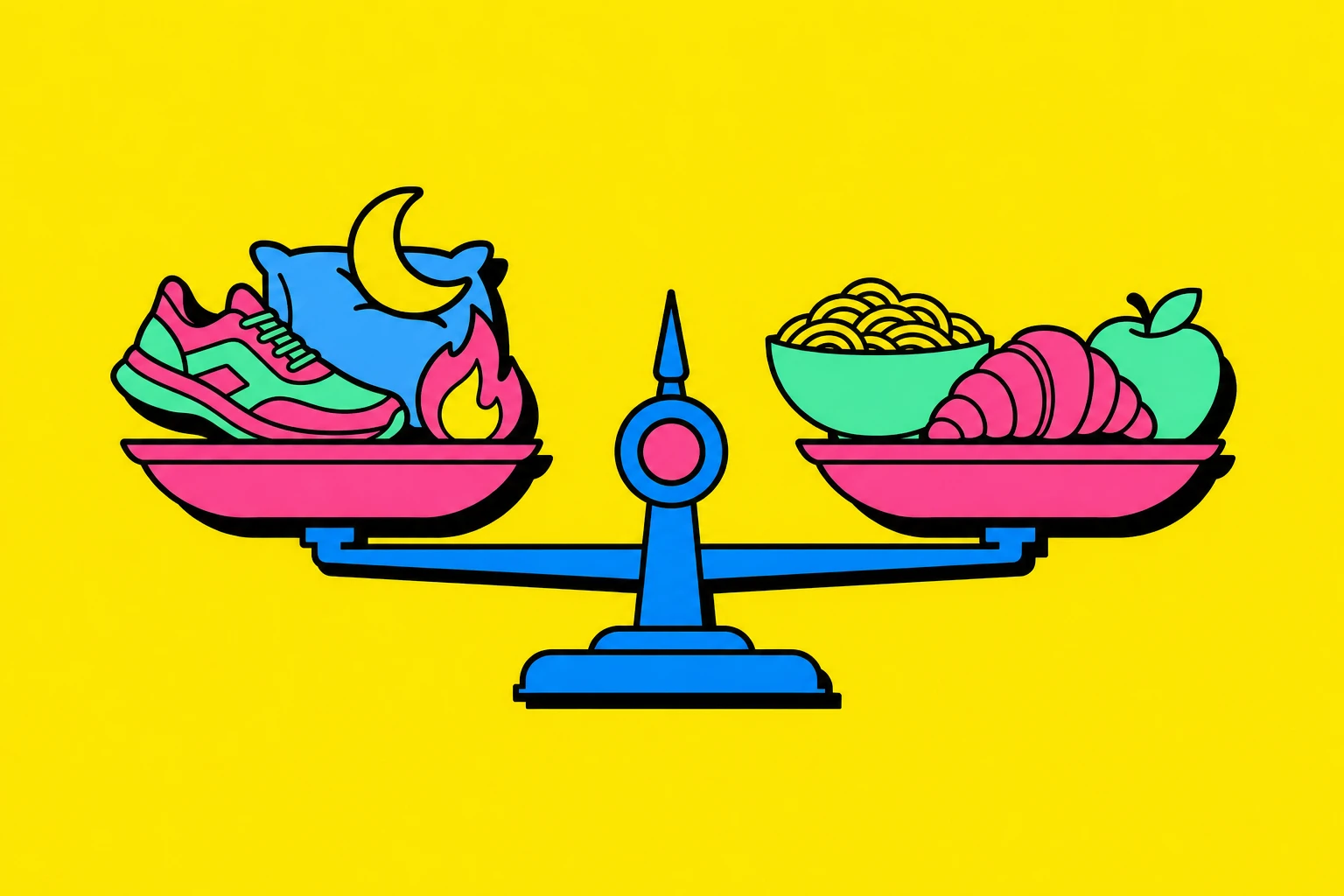
Then there’s energy balance. It’s a dull idea, but everything else in this series rests on it. Picture a pair of scales.
On one side is what you burn:
- BMR (basal metabolic rate), the energy your body needs just to stay alive. It depends on your weight, height, age and how much of you is fat.
- EAT (exercise activity thermogenesis), exercise: how much you lift, run or dance.
- NEAT (non-exercise activity thermogenesis), all the movement that isn’t exercise: your daily steps, whether you sit at a desk or load trucks, whether you carry the groceries home or order delivery.
- TEF (thermic effect of food), the energy it takes to digest and absorb your food.
Add them up and you get a rough number of calories you need in a day to walk, eat, sleep, digest and work. That number is your Total Daily Energy Expenditure, or TDEE. You can estimate yours with the TDEE calculator. Deficit works it out for you, and then corrects it from your real results.
Example · 2,500 kcal a day
- BMR · Staying alive 1,650 kcal · 66% breathing, heartbeat, keeping warm
- NEAT · Moving around 450 kcal · 18% steps, chores, fidgeting
- TEF · Digesting 250 kcal · 10% breaking down what you ate
- EAT · Exercise 150 kcal · 6% a few workouts a week, averaged
This number differs a lot from person to person. People who train and move a lot (lifting, running, cycling, tennis) can need hundreds of calories a day more than someone the same size with a desk job. Here are two people with the same body, by the TDEE calculator’s math:
| Same body: 80 kg (176 lb), 20% body fat | Desk job, no training | Trains 5+ times a week, 12,000+ steps a day |
|---|---|---|
| Activity level (PAL) | 1.10 | 1.40 |
| Calories a day (TDEE) | ~2,300 | ~2,950 |
Two more things burn no energy directly but change how much you want to eat: stress and sleep. Short sleep makes you hungrier, and it changes what you lose. In one small study, dieters who slept 5.5 hours a night instead of 8.5 lost less than half as much fat on the same diet, and more lean mass.
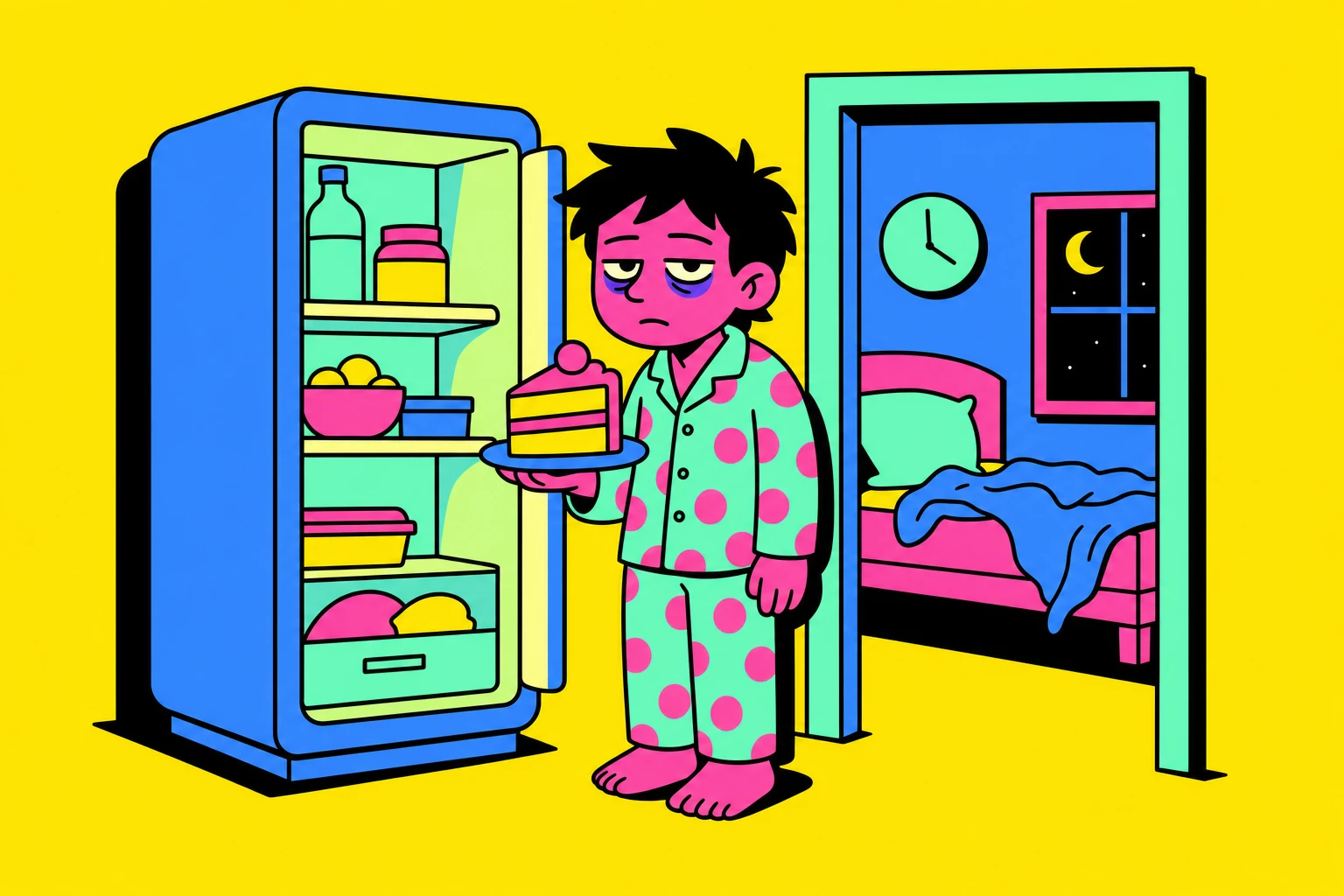
On the other side of the scales is how much you eat, and what. If weight is the only thing you watch, the rest is fairly simple. Eat more than you burn, and your body carefully stores the extra as fat: you gain. Burn more than you eat, and your body has to draw on its stores: you lose. Keep the two even, and your weight stays where it is.
Here’s how this works in numbers. Take the simplest case: someone with a lot to lose (65 lb / 30 kg or more). Early on, almost all of what they lose is fat, and each pound of it is worth about 3,500 calories. So eating 500 calories a day under their TDEE comes to about a pound (450 g) a week. A leaner person loses too, but each pound costs fewer calories and part of it is muscle, not fat. And for everyone, the pace slows as the body gets smaller.
A safe pace for weight loss is 0.5–1% of your body weight a week. A sensible pace for gain is anywhere from 0.25% to 2% a month, depending on how long you’ve trained and a dozen other things.
How fast
That’s the whole reason counting works. There’s nothing clever in it. It’s a boring tool for keeping track of energy balance.
Why count calories? Just eat less!
On the whole, you can lose weight without counting. There are plenty of ways, and all of them work, under certain conditions:
| Method | Expectation | Reality |
|---|---|---|
| Intermittent fasting | Fasting burns off the extra faster | You eat less: a calorie deficit |
| No food after 6 pm | Food at night stops turning into fat | You eat less: a calorie deficit |
| No carbs | Carbs are what make you fat. Cut them and you lose weight | You eat less: a calorie deficit |
| No fast food | Fast food is evil! | You eat less: a calorie deficit |
| No snacks | Meal timing must be what matters most | You eat less: a calorie deficit |
| More vegetables | Vegetables burn fat | You eat less: a calorie deficit |
| No delivery, cook for yourself | Home food is healthy food | You eat less: a calorie deficit |
| No alcohol | It's sad, but what can you do | You eat less: a calorie deficit |
| Move more | Running and intervals help you lose weight! | A calorie deficit (but not for sure) |
I once lost 5 kg (75 → 70, about 11 lb) just by being more active. I moved to Prague and walked a lot, and there you’re always walking either up a hill or down one. Then I had to quit alcohol for medical reasons, and the weight came off without me even noticing.
Some people see a different version of reality: “I don’t eat anything extra, and my weight goes up.” Well, sure, sometimes I let loose on the weekend, but on the whole I eat healthy™ food (the lunch special near the office). I don’t fry anything, I eat vegetables, I don’t eat sugar, I don’t drink soda. I even go to the gym now and then, and I walk more than a thousand steps a day. And my weight won’t even think about going down. It keeps climbing, month after month.
The saddest case is when the methods are already in place, but they don’t help. How do you tell what’s going on? Do the measures really not work, and there’s a deeper problem? Were they just put in place wrong? Or maybe the stress of quitting alcohol gets made up for with sweets and pizza?
Calorie counting is a deeper diagnosis of the problem. It gives you the level of detail you need.
The pros of counting calories
1. Counting audits your food and shows you how much you really eat
With “I eat right and my weight goes up,” it’s simple in the vast majority of cases: somebody’s lying people just don’t know how many calories are really in their food, or what “right” even means. In one study, people who said diets didn’t work for them overestimated their physical activity by 51% and underestimated how much they ate by 47%.
Counting opens your eyes. It’s one thing to know in the abstract that drinks with alcohol are high in calories, but not know how high (and then wonder where the extra pounds came from). It’s another thing to type the actual numbers into a tracker by hand and see what tonight cost you against your daily target.
Anton, one of the people I helped, went from 120 to 80 kg (265 to 175 lb). Early on, he told me his total for the day was 2,000 calories. He also told me he’d gone to a bar that evening. Those two things didn’t add up. It turned out he didn’t count the cocktails, because he didn’t know he had to. He sent me the receipt from the bar, and we worked it out together: the real total was about 4,000.
Along the way, you might learn that:
- your morning pastry is 500 calories
- a plate of carbonara is 1,000
- your daily limit is 1,600 🤡
- fruit isn’t sugar-filled evil
- 100 g (3.5 oz) of cheese on top of a pork chop, or a few tablespoons of honey in your Greek yogurt, can easily wipe out all your efforts to eat at a deficit
A separate point: once you count, there’s a good chance you’ll find out you eat very little protein. All my life I thought I got enough meat. When I counted, I quickly saw I wasn’t eating even 50% of the recommended amount. Protein is less about six-pack abs for gym bros and more about immunity and feeling full. So a diet tilted heavily toward fatty and carb-heavy food leaves you never quite full. Then you just eat more often and more, and end up eating more calories.
A nice bonus: counting teaches you what’s in your food, and how much. At first you know nothing. Over time, you just know what you can afford and what you can combine, without a tracker. This is also called intuitive eating.
2. Counting helps you build an accurate model for managing your weight and body fat
Say I want to lose weight and don’t want to count calories. I quit alcohol completely and give up sweets. A week later, I see results. I’m happy, because it works!
Time passes, and I keep losing weight. True, I haven’t had my favorite orange wine in two months, and I haven’t touched a good dessert. It’s sad, but the weight is going, so I’m suffering for a reason. Then the weight starts coming off more slowly, or stops altogether. The goal isn’t reached, the bottle of wine glints sadly from the fridge, and it’s not clear what to do.
So what do I do? Start running? Give up fatty meat? Stop eating fruit? Buy fat burners? Boil chicken breast?
Now picture a parallel universe:
- I know how much food I need
- that amount is in numbers (not an abstract “palm-sized portion”)
- I know how much weight I can expect to lose (or gain) over a period of time
I calmly have my wine once a week, and share a slice of honey cake with my wife. Or I have two slices of my own, and pick something slightly different at the restaurant (or skip a meal). That’s exactly what counting is for. It gives you control and predictability. Control and predictability help motivation, and they help you make changes in time when something goes wrong.
3. You can eat anything, without cutting out specific foods
What’s the best diet? The one that gets results and is easy to stick to at the same time. It doesn’t matter how scientific and correct a list of 50 restrictions and rules is if you can’t actually follow it.
In the orange wine and dessert example, the goal still isn’t reached, and the restrictions haven’t gone anywhere. If you tighten the screws and add more restrictions, at best it just makes life less comfortable. In the middle-to-bad case, it leads to frequent slip-ups. At worst, it can lead to mental health problems and trigger eating disorders, when people start obsessively hunting for traces of sugar and oil in any food. Eating disorders are a very grim group of diagnoses, with expensive treatment that isn’t guaranteed to work, and any diet with a pile of restrictions can be the first step. So can the overblown stories that carbs/fruit/sugar/gluten/fats/desserts/oils/dairy/productName are evil. In specific cases with specific medical reasons, sure, anything is possible. But in general, there are almost no bad foods.
The big plus of a flexible diet and counting, compared with any restrictive diet, is that you really can have everything. Want fries? I eat them (within my numbers). Want dessert? I eat it (within my numbers). With counting, I know how much of what I can eat without hurting my goals, and I fit a useless but tasty orange wine into a specific day. No forbidden foods, no reasons to fall off the wagon.
The calories fit into your daily deficit? If your goal is to lose weight, you’re on your way.
Of course, your goals can be such that even with counting, your favorite food still won’t fit, so don’t take “you can eat anything” literally. Five burgers a day won’t fit even for Dwayne Johnson. If something dear to your heart systematically doesn’t fit, you’re not a competitive IFBB pro, and you feel bad, think about whether your goals are good ones, and why you’re doing all this.
It’s worth saying that “the calories fit my daily limit” doesn’t mean “healthy food.” If you try hard enough, you can lose weight and your health at the same time. But healthy eating is outside the scope of this article.
The cons of counting calories
1. Counting properly is hard, and counting improperly is pointless
No convenient food tracker with a quick pick for any food makes up for the fact that honest counting means weighing all the ingredients of a dish separately. Then working out how much of it is in your portion. All the ingredients: all the sugar, the flour, the oil in it, the oil in the pan, the oil on top, the honey, the sauces, the mayo, the pasta, the tomato paste, the anchovies. Everything.
Logging only the foods that were easy to count is not counting. Finding a similar dish and logging that is not counting. Eyeballing it, or picking the first similar item from the list, is not counting. One popular tracking app I used listed a serving of “Pasta with carbonara sauce” at 300 calories. That’s 2.5–3 times less than a real carbonara. And high-calorie extras (especially sauces, honey, cheese, oils and nuts) can easily double a dish’s real calories. By Murphy’s law, they’re exactly the things that are harder to count than everything else.
In the first couple of weeks, before you build the habits and routines, you can spend 10 minutes just weighing and logging one complicated dish, and it’s incredibly annoying. Then it gets easier. But personally, I never got to the point where counting brings me peace. It still causes a mild background irritation.
2. Counting restaurants and delivery works poorly
If 90% of what you eat is lunch specials, cafés and delivery, counting is simply pointless. Simply because you’ll never know what lovely sauces and oils the chef used to make your dish tasty. And the ingredients in the average lunch special are far from always high quality: cheaper (and fattier) cuts go in.
Of course, there are tricks that can help, like ordering very simple dishes with clear ingredients. You can also look up the dish’s nutrition info (many chains list it on the menu or the website) and enter it into your tracker, allowing for about 20% error.
On the other hand, there’s no real alternative. If you’re serious about staying in shape, you need to cut down on eating out, to 30% of what you eat at most. You’ll have to learn to cook, and even spend time on it. Future you will say thanks.
3. Counting gets in the way of a normal relationship with food
Counting replaces your natural appetite controls (hunger and fullness signals) with little numbers in a tracker. Losing weight is stress for the body, and the closer your weight is to “optimal,” the stronger the stress. All together, it hits your head hard. If you lose weight and count for too long and/or very wrongly, nothing good will come of it. I’m not a fan of random internet diagnoses, but a real eating disorder isn’t that far from what people do to themselves when they count for a long time and do it wrong. That’s why I personally argue that counting should be a time-limited experiment, with one goal: to fix your eating habits.
Sources
- Non-exercise activity thermogenesis (NEAT). Levine JA. Best Pract Res Clin Endocrinol Metab. 2002. (PubMed)
- Insufficient sleep undermines dietary efforts to reduce adiposity. Nedeltcheva AV, Kilkus JM, Imperial J, Schoeller DA, Penev PD. Ann Intern Med. 2010. (PMC)
- What is the required energy deficit per unit weight loss?. Hall KD. Int J Obes. 2008. (PMC)
- Discrepancy between self-reported and actual caloric intake and exercise in obese subjects. Lichtman SW, Pisarska K, Berman ER, et al. N Engl J Med. 1992. (PubMed)