
How to set up a structured cut
Most cuts fail in the setup, not the willpower. People pick a round-number calorie target, eat at it until they're tired of it, and stop with no idea whether it worked. A structured cut fixes that by deciding the whole thing up front: how long it runs, how big the deficit is, where protein sits, and what you change each week. Here is how to set one up.
What is a structured cut?
A structured cut is a fat-loss phase with a start, an end, and a plan for the middle. It has four fixed parts: a length (usually 4 to 12 weeks), a calorie deficit sized to your real maintenance, a protein floor that holds while calories drop, and a weekly adjustment that keeps the rate on target. When the weeks are up, you stop and return to maintenance. That last part is what separates it from open-ended dieting, which has no finish line and tends to drift until motivation runs out.
How long should a structured cut be?
Four to twelve weeks, with eight a sensible default for most people. Short enough that you can hold the deficit without adaptation and fatigue stacking up, long enough to lose a meaningful amount of fat. Reviews of lean-physique dieting favor moderate-length cuts at a controlled rate over aggressive crash diets, which cost more muscle for the same fat loss. If you have more to lose than twelve weeks allows, run a block, take a few weeks at maintenance, then run another, rather than dragging one deficit out indefinitely. The case against the never-ending diet is its own topic.
Step 1: Find your real maintenance calories
Everything keys off the number of calories that holds your weight steady. Get it wrong and every week is off by the same margin. The accurate path for a trained person runs through lean body mass: estimate body fat, derive lean mass, run it through the Cunningham equation for resting metabolism, then add activity. The lean body mass calculator does the full chain; the TDEE calculator stops at the maintenance figure if that's all you need, and why Cunningham fits athletes explains why a weight-based equation undersells a muscular body.
Step 2: Set the deficit
Subtract enough to lose about 0.5 to 1% of your bodyweight per week. For most people that lands near a 20 to 25% cut below maintenance, often somewhere around 500 calories a day. That rate is fast enough to see progress and slow enough to protect muscle and training quality. Going steeper rarely speeds fat loss much; it mostly adds hunger, drops gym performance, and raises the share of weight lost as muscle.
A worked example, using the same lifter from the Cunningham post:
| Input | Value |
|---|---|
| Maintenance (TDEE) | 2,800 kcal |
| Deficit | 500 kcal (~18%) |
| Daily target | 2,300 kcal |
| Expected loss | ~0.45 kg / week |
Step 3: Set your protein
Protein is the one macro you raise as calories fall, because it defends muscle in a deficit and keeps you full. Anchor it on lean body mass rather than scale weight, which is the difference between a target that fits a lean body and one that overshoots for someone carrying more fat. For the lifter above, roughly 2.4 grams per kilogram of lean mass puts protein near 170 grams a day. The bodyweight-or-lean-mass question covers why the anchor matters, with worked numbers. Fill the rest of the calories with carbs and fat in whatever split you train and eat best on.
Step 4: Adjust week to week
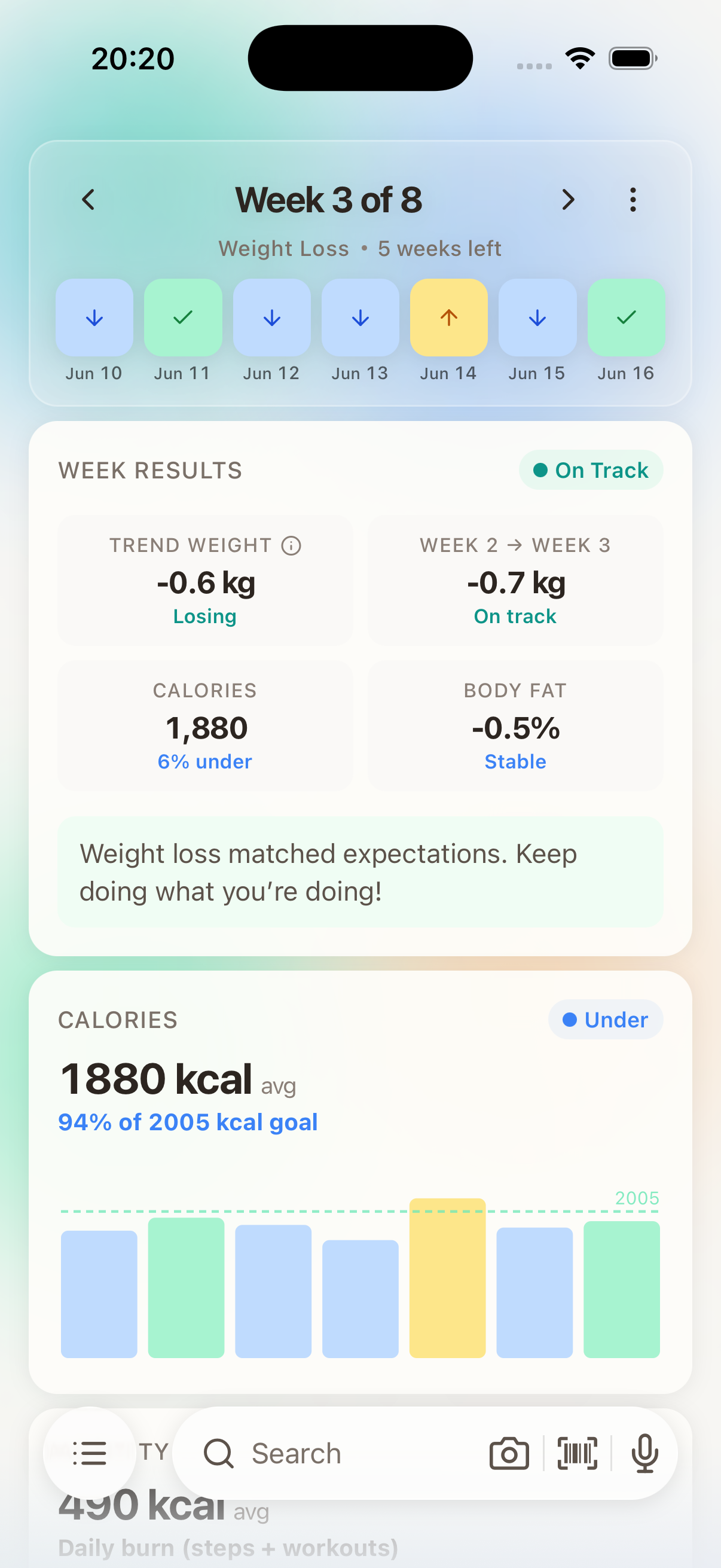
The deficit you set on day one is an estimate, and your body will tell you over the first two weeks whether it was right. Weigh daily, average the week, and compare the trend to your target rate. Losing faster than about 1% of bodyweight a week, add a little food. Stalled for two weeks straight with honest logging, trim a little. One change a week, judged on the weekly average rather than any single morning. This loop is the whole engine of the method; the weekly check-in walks through it, and how Deficit works shows the algorithm that automates it.
Step 5: Know when to stop
A structured cut ends on its end date, not when the scale hits a number. When the weeks are done, walk calories back up to maintenance over a week or two and hold there. The break lets appetite, training, and hormones recover, and it locks in the weight you lost instead of sliding into the slow regain that follows an exhausted, open-ended diet. If you have more fat to lose, that maintenance phase is also the launch pad for the next block.
The whole setup in one place
Pick a length. Find maintenance. Subtract a deficit sized to half a percent to one percent of bodyweight a week. Set protein on lean mass. Adjust once a week off the trend. Stop on the date and return to maintenance. Each step has a tool or a deeper write-up linked above, but the shape never changes: decide the cut before you start it, then let the weekly data steer.
Frequently asked questions
How long should a cut last?
Four to twelve weeks, with eight a good default. Long enough to lose meaningful fat, short enough to hold the deficit before fatigue and adaptation build up. For more fat than that window allows, run several blocks separated by maintenance phases rather than one extended diet.
How big should the calorie deficit be?
Size it to lose about 0.5 to 1% of bodyweight per week, which for most people is roughly 20 to 25% below maintenance, often near 500 calories a day. Steeper deficits rarely speed fat loss much and cost more muscle and training quality.
How much protein on a cut?
Keep protein high and anchored on lean body mass, since it defends muscle while calories are low. Around 2.3 to 3.1 grams per kilogram of lean mass is a well-supported range for lean, training people in a deficit. Anchoring on lean mass rather than scale weight avoids overshooting for those carrying more fat.
What do I change when weight loss stalls?
First confirm the stall is real: weigh daily and read the weekly average, not a single day. If the trend is genuinely flat for two weeks with honest logging, cut a small amount of calories or add activity, then hold for another week before judging again. Change one thing at a time.
Sources
- Eating & Physical Activity to Lose or Maintain Weight. National Institute of Diabetes and Digestive and Kidney Diseases (NIH). (NIDDK)
- Evidence-based recommendations for natural bodybuilding contest preparation: nutrition and supplementation. Helms ER, Aragon AA, Fitschen PJ. J Int Soc Sports Nutr. 2014. (free full text, PMC)
- International Society of Sports Nutrition Position Stand: protein and exercise. Jäger R, et al. J Int Soc Sports Nutr. 2017. (free full text, PMC)
- Protein supplementation and resistance training-induced gains in muscle mass and strength: a systematic review and meta-analysis. Morton RW, et al. Br J Sports Med. 2018. (PubMed)
- Dietary Guidelines for Americans (USDA / HHS). U.S. Departments of Agriculture and Health & Human Services. (dietaryguidelines.gov)
Deficit is our iOS app. It handles all of this for you, and the first week is free.